
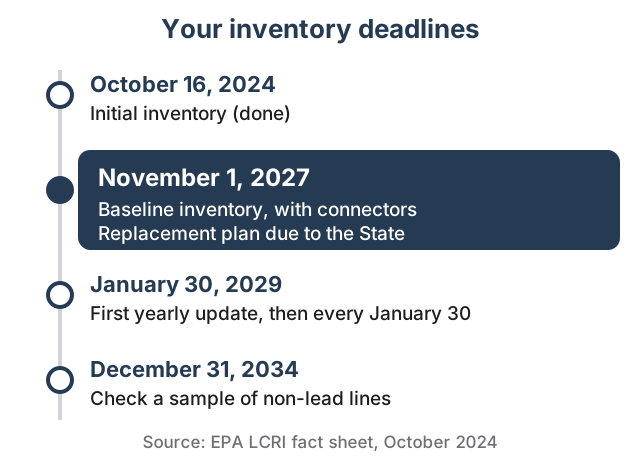
Every water system in the US has a date to remember: November 1, 2027. That is when your baseline lead service line inventory is due. Your service line replacement plan is due to the State on the same day.
You probably sent in an initial inventory in 2024. The new one asks for more. It adds connectors, and it starts a list you must keep current every year. This post explains what is due, what a connector is, and how a small utility can build the list without a GIS department.
This rule is US only. It comes from EPA, so Canadian utilities are not covered.
What exactly is due on November 1, 2027?
Two things are due. The first is the baseline inventory. It builds on the initial inventory you filed by October 16, 2024. It must include your connectors and any new facts you have learned about your service lines.
The second is the service line replacement plan. You need one if you have even one lead, galvanized requiring replacement, or unknown line. The plan explains how you will find the unknowns and how you will replace the lead lines. It also covers how you will pay for the work and how you will tell people about it.
A service line is the pipe from the water main to the building. EPA asks you to sort every line into one of four groups:
| Group | What it means |
|---|---|
| Lead | Any part of the line is lead. A lead-lined galvanized line counts as lead. |
| Galvanized requiring replacement | A galvanized steel line that is or ever was downstream of a lead line, or is downstream of an unknown line. |
| Non-lead | You have evidence, a record or a test, that it is not lead and not this galvanized type. |
| Unknown | You have not shown what it is made of yet. |
Galvanized requiring replacement is a mouthful, so EPA shortens it to GRR. If you cannot prove a galvanized line was never downstream of lead, it is a GRR line.
What counts as a connector?
A connector is a short, bendable piece of pipe. It is no longer than 3 feet. Crews often call it a gooseneck or a pigtail. It usually joins the service line to the water main.
Many old connectors were made of lead, even when the rest of the line was not. That is why EPA now wants them on the list. You must sort each connector as lead, non-lead, unknown, or no connector present.
What happens after the baseline is filed?
The inventory becomes a living list. EPA uses that exact phrase. You update it as you replace lines and learn what the unknown lines are made of.
Here are the dates that follow the baseline:
- By January 30, 2029, you file your first yearly update and post it. After that, you file one every January 30.
- The update shows counts for each line material and for lead and unknown connectors. It also counts the full and partial replacements done that year.
- By December 31, 2034, or on your State's schedule, you check a sample of your non-lead lines to prove the list is right.
- You must replace all lead and GRR lines under your control within 10 years, unless your State sets a different deadline.
The public must be able to see the inventory. Systems that serve more than 50,000 people must post it online. Smaller systems can post it online, mail it, or keep it at the office. Starting with the baseline, it must show the street address of each service line and connector.
How do you find the unknown lines?
Most small utilities have many unknowns. The records exist, but they are scattered. Some are on tap cards. Some are on old paper maps. Some live in a retired employee's memory.
A good approach works in rounds:
- Gather every record you have: tap cards, work orders, meter change notes, and building dates.
- Put each service line on a map, tied to its street address.
- Fill in what the records already prove. Each fact you add shrinks the unknown pile.
- Plan field checks for the lines that are left. Group them by street, so one crew visit covers many lines.
- Log what the crew finds on site, with a photo, right on the map.
Building dates help a lot. Many cities stopped installing lead lines at some point. Ask your State what evidence it accepts before you rely on a date alone.
Why put the inventory on a map?
A spreadsheet can hold the list. A map makes it easier to act on.
On a map, you see clusters of unknowns on one block. You can send one crew to check them all in a morning. You can see which lead lines sit near a water main project, so you replace them while the street is already open.
The yearly update also gets easier. When crews log their work on the map, the counts add up on their own. On January 30, you export the totals instead of counting rows by hand.
The address rule matters here too. Each line and connector needs a street address, or another location like a block or GPS point. A map stores that for every line.
Can a small utility do this without a GIS director?
Yes. You do not need a full GIS department. You need three things: one clean map layer of service lines, a simple field form for crews, and someone to keep it running.
That last part is where small utilities get stuck. The staff who know the pipes are busy fixing them. Nobody has time to build the map and keep it current.
This is the gap an outside engineering team can fill. They set up the map and the field form. Your staff keep doing what they know best: finding and replacing pipes.
How do we do it at GeoLink?
We have built this pattern before, for sewer work. On our POSM GIS Enterprise project, field crews see thousands of sewer assets on one live map. They keep working on offline maps when there is no signal. Their work syncs back to a central SQL Server.
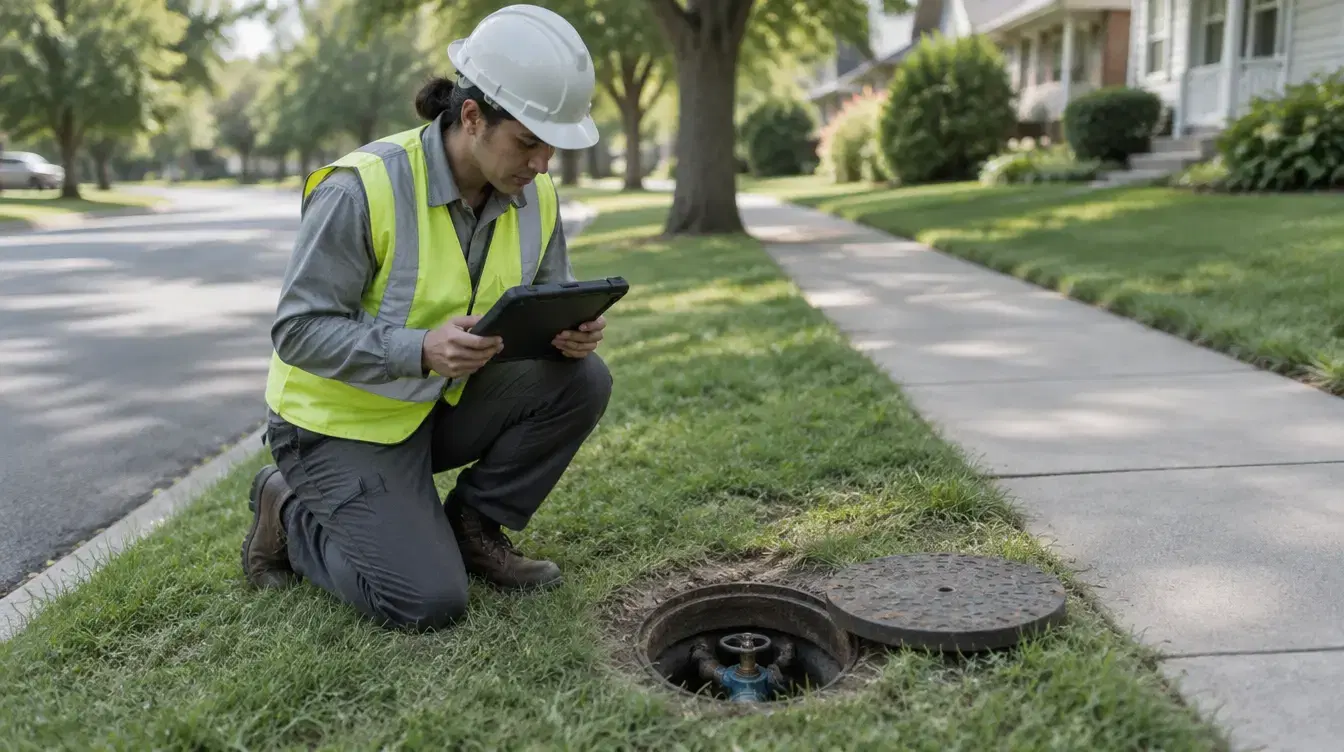
A service line inventory works the same way. Each line is a point on the map with its material, its connector and its evidence. A crew updates it on a tablet at the curb. The office sees the change the same day.
Your utility keeps its own accounts and its own data. We set up the workflow and train your staff to run it.
What should you do in the next 90 days?
You have time, but not a lot of it. Here is a short plan:
- Count your unknowns. Your initial inventory already tells you how many lines are unknown.
- Find your records. List every place service line facts live today, on paper or on a server.
- Ask your State what evidence it accepts for non-lead lines and connectors.
- Pick one neighborhood and map it first. A small test shows how long the rest will take.
With that list in hand, a free 30-minute audit can tell you how close you are to a baseline inventory. We will tell you plainly if you can finish it on your own.